

One of the most common questions asked by investors considering rooming accommodation is, “How do you calculate the rent for each room?”
Many people assume there is a simple formula based on the number of bedrooms or the suburb in which the property is located. In reality, calculating room rents is both an art and a science, with dozens of factors influencing what a tenant is willing to pay.
The most successful rooming house operators don’t simply charge what everyone else charges. They understand their target market, design specifically for that market, and create a product that delivers exceptional value. The result is more demand, significantly higher rental income and stronger long-term investment returns.
At Brisbane Rooming Houses, we have spent years refining this formula, consistently achieving the highest room rents in the suburbs in which we operate.
There Is No Standard Rooming House Rent
One of the biggest misconceptions about rooming accommodation is that all rooming houses are essentially the same.
Nothing could be further from the truth.
Rooming houses vary enormously in land size, architectural design, room dimensions, construction quality, inclusions, management standards and the demographic they target. Some offer little more than a bedroom with shared facilities.
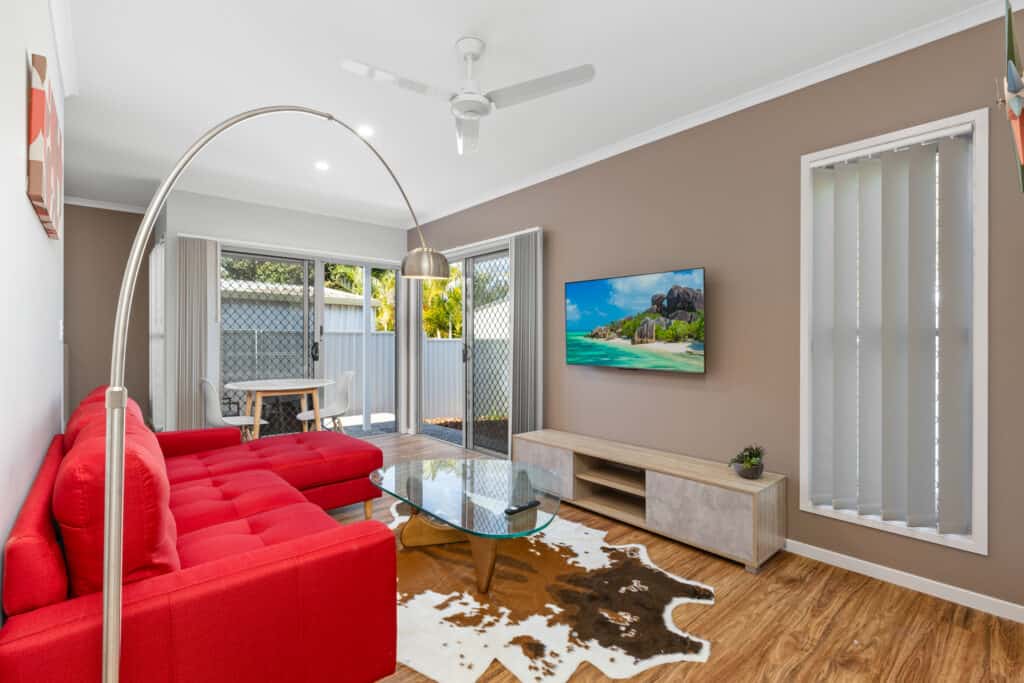
Others provide executive-style accommodation with designer kitchens, luxury bathrooms, premium furnishings, high-speed internet, landscaped outdoor entertaining areas and hotel-quality finishes.
Just as a budget motel cannot command the same nightly rate as a five-star hotel, a basic rooming house cannot expect to achieve the same rental return as a premium executive rooming house. The quality of the product ultimately determines the quality of the rent.
The Range of Room Rents
Across the market, room rents can vary dramatically.
At the lower end, a renter may pay approximately $360 per week for a bed in an average, standard rooming house with basic shared facilities and minimal inclusions.
At the premium end of the market, in the same suburb or street, larger studio-style rooms in high-end designer homes with private ensuites, quality furnishings and extensive inclusions regularly achieve $550 per week or more in suburbs where other rooming accommodation houses fetch $200 less per room.
The difference is not simply the size of the room.
It is the complete living experience.
Construction quality, thoughtful designer homes, privacy, comfort, functionality and presentation all contribute to what renters perceive as value.
When people are proud of where they live, and have a better living experience, they are generally prepared to pay more.
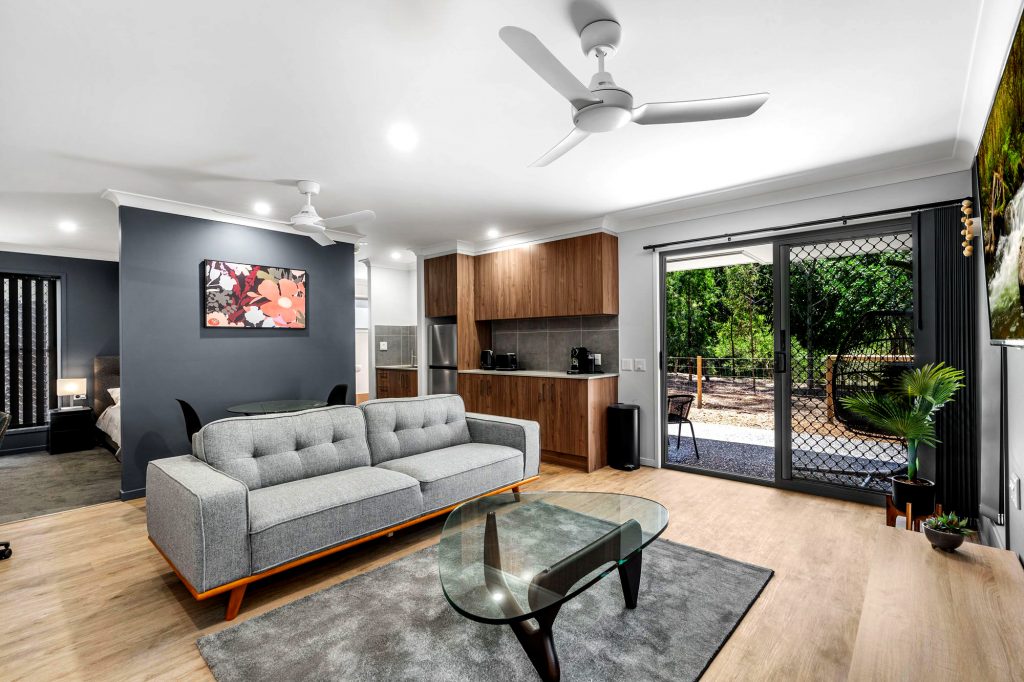
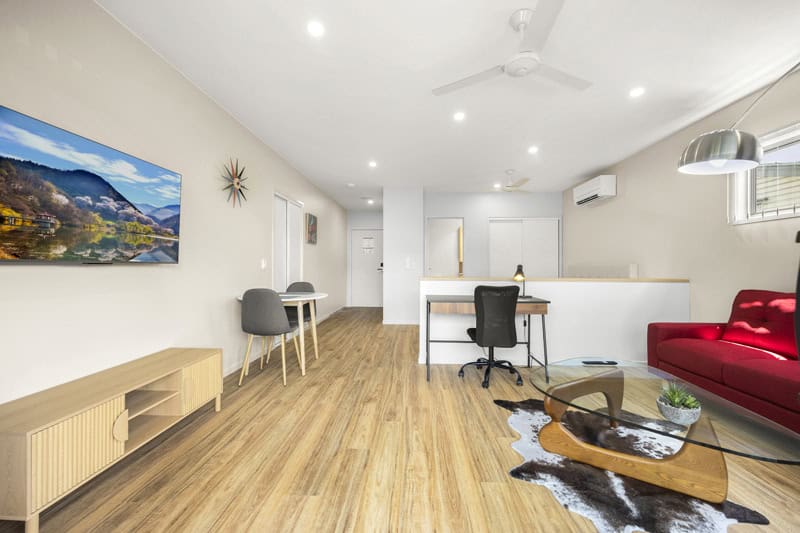
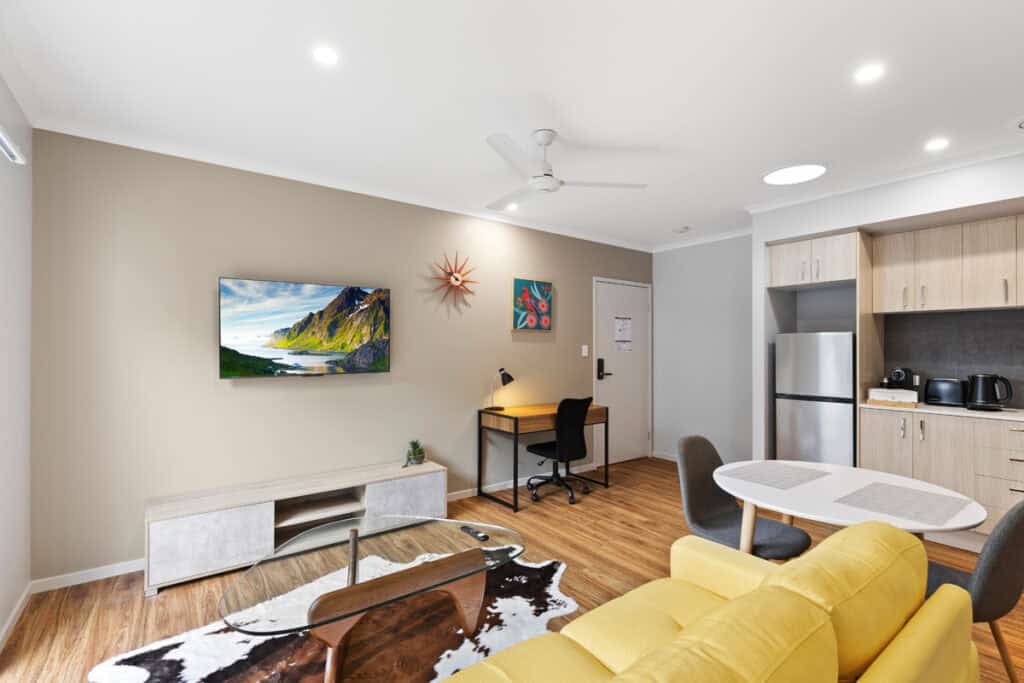
Above: Premium Executive Living Studio rooms by Brisbane Rooming Houses ©
Renters Compare Value, Not Just Price
Today’s renters are informed consumers.
Before committing to a property, they compare multiple options online and inspect competing accommodation.
While price is important, it is only one factor in the decision-making process.
Renters ask themselves:
- How does the house and room feel?
- Is the property modern?
- Is it clean and well maintained?
- Is it safe and secure?
- Are the rooms spacious?
- Is the internet reliable?
- Is the room sound proof?
- Are the communal spaces attractive?
- Is it well furnished?
- Are the furnishings good quality?
- How many inclusions are there?
- Is there adequate or extra storage?
- Does it offer privacy?
- Is it close to work?
- Does it have garaging or off street parking?
- What size is the TV ?
- How large is the fridge?
- What size is the bed?
- Does the room have air conditioning?
- etc…
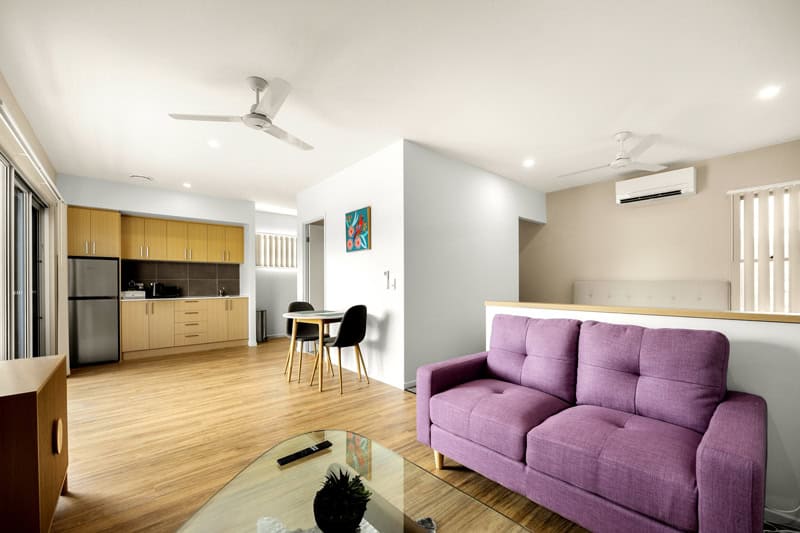
© Brisbane Rooming Houses
If they believe the accommodation offers outstanding value, they are often willing to pay substantially more than the cheapest alternative.
If they cannot see the value, they will simply continue searching.
For this reason, successful rooming accommodation providers compete on quality rather than price.
The Advantage of All-Inclusive Rent
One of the greatest attractions of executive rooming accommodation is the simplicity of an all-inclusive rental package.
While many operators include utilities, others charge separately.
At Brisbane Rooming Houses, all bills are included, giving residents certainty and convenience.
Their weekly rent includes:
- Electricity
- Water
- High-speed internet
- Furniture
- Appliances
- Cooking utensils
- Kitchenware
- Whitegoods
- Common area maintenance
This means residents avoid unexpected expenses and can budget with confidence.
There are no electricity accounts to establish, no internet contracts to organise and no need to purchase thousands of dollars’ worth of furniture before moving in.
Everything is ready from the day they arrive.
That convenience has real value.
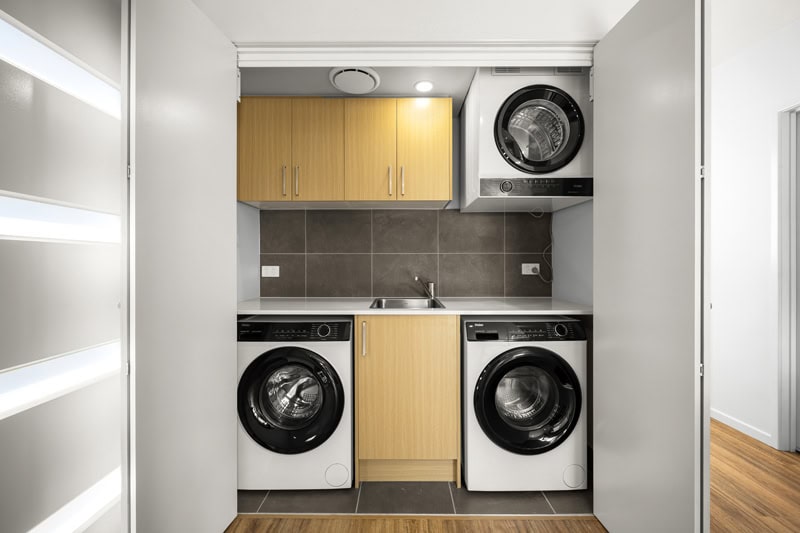
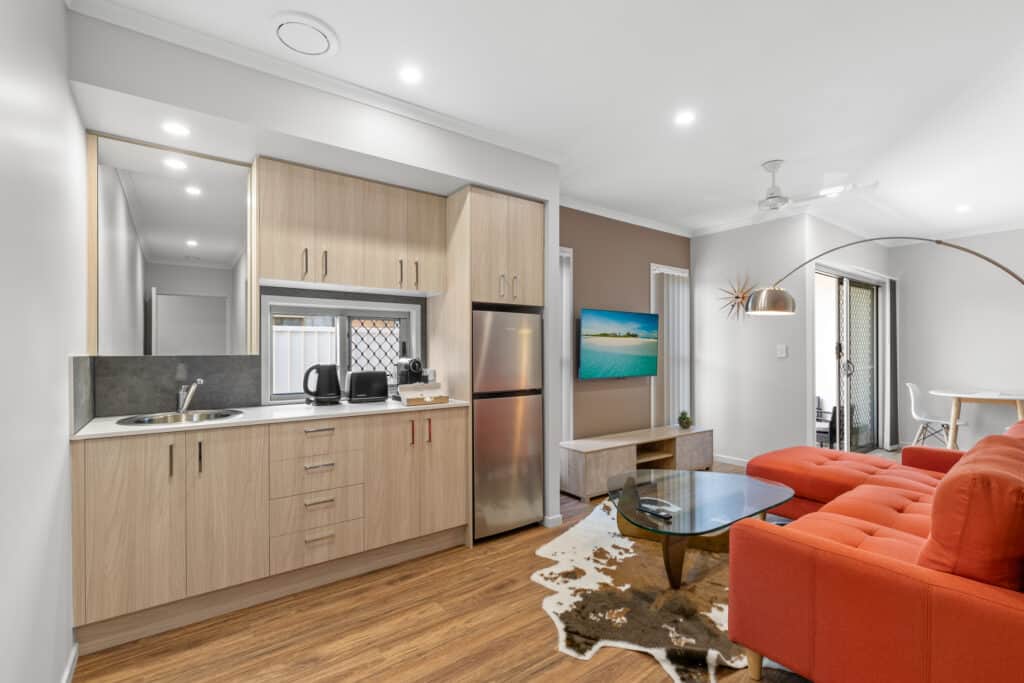
Picture 1. Laundry inclusions – two washing machines and dryer with quality cabinetry. Picture 2. A resident’s room with quality cabinetry and premium furnishings. © Brisbane Rooming Houses
Why Rooming House Residents Can Afford Higher Rent
Traditional housing affordability guidelines suggest people should spend approximately 30% of their income on housing costs.
However, executive rooming accommodation operates under a different economic model.
Because furniture, appliances, internet, utilities and household essentials are included, residents have significantly fewer additional expenses.
As a result, a rooming house resident can comfortably allocate 40% to 50% of their income towards rent, while still enjoying manageable overall living costs.
For many busy professionals, paying one weekly amount that covers virtually every household expense is both convenient and financially sensible.
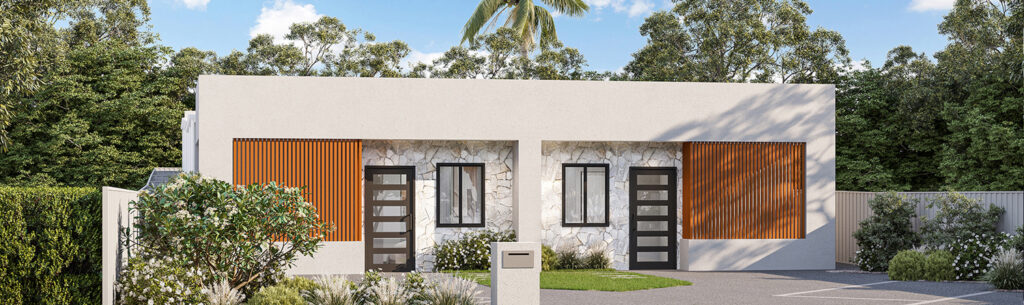
The ‘Kirra‘ low-set model offers superior, designer living for renters wanting a better living experience. © Brisbane Rooming Houses
Understanding Your Target Market
Perhaps the most important factor in calculating room rent is understanding exactly who your target customer is.
Different rooming house builders and operators deliberately target different income brackets.
Some focus on lower-income renters, where affordability and lower rents are the primary drivers.
Others focus on essential workers and middle-income professionals seeking quality accommodation close to employment centres.
At Brisbane Rooming Houses, our target market is middle-to-high income earners with annual incomes generally exceeding $70,000 per year.
Our room rents are therefore designed around this demographic.
Considering the average Australian annual income is approximately $90,000, our accommodation represents outstanding value for professionals earning average or even below-average wages, despite commanding premium room rents.
Professional Property Management Matters
Determining achievable rent involves much more than looking at neighbouring properties.
A good property manager will collate room applicant information including the applicant’s occupation, place of work and income (as well as a background check with their employer and their rental history).
A typical non-Rooming House renter can afford to pay about 30% of their income on rent.
However, a rooming house resident can afford to pay more of their income because all furnishings, appliances, kitchenware, utensils and all bills are supplied, no more to pay.
“A rooming house renter can afford to pay about 40% to 50% of their income on rent.”
At Brisbane Rooming Houses we target middle-to-high income earners on at least $70,000 income. Our room rents are set accordingly.
Considering the average Australian income is around $90,000 pa., we represent excellent value for someone earning $20,000 less than the average Australian income, even though we do get the highest rents for our Rooming Houses than other Rooming Houses offered by others, even in the same street – and even compared to rooms in Rooming Houses next door.
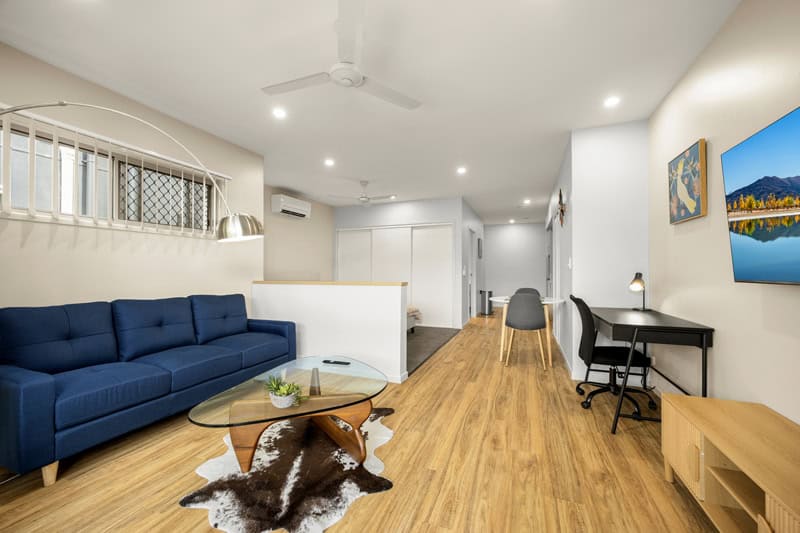
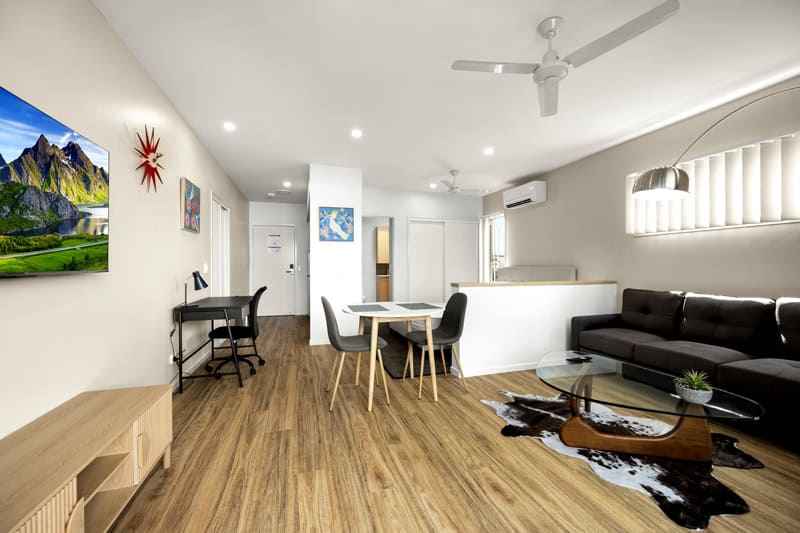
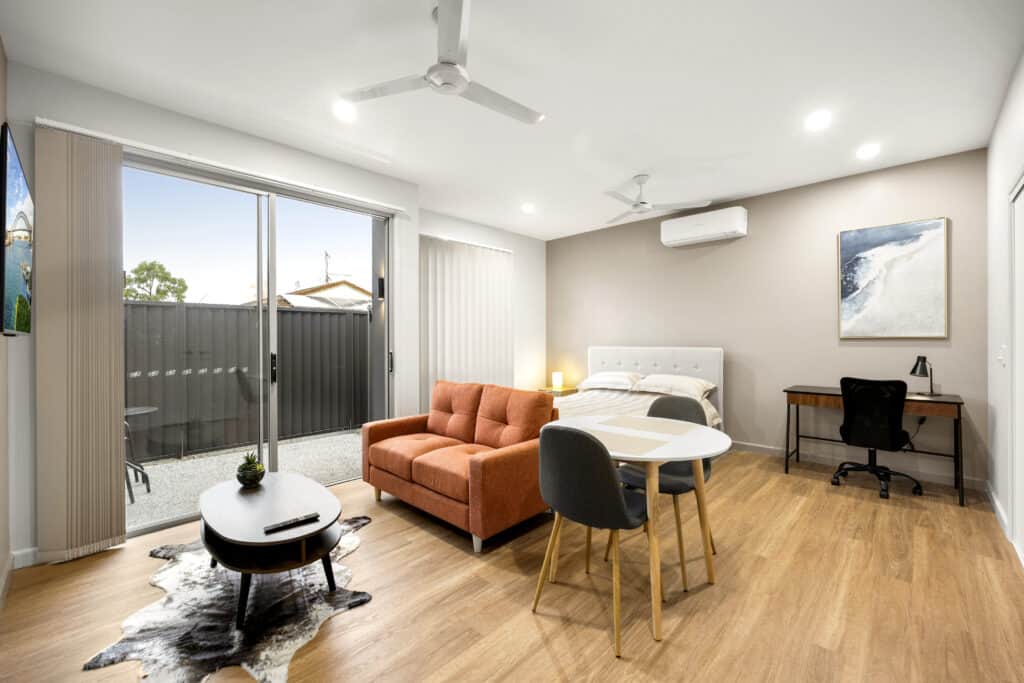
Above: Large, quality Executive Living rooms will attract professional residents preferring a better living experience. © Brisbane Rooming Houses.
This process typically includes verification of:
- Occupation
- Employer
- Income
- Rental history
- References
- Background information
Understanding a resident’s financial position and employment stability allows managers to match suitable tenants with appropriate accommodation.
This contributes to stronger occupancy, longer tenancies and more reliable rental income.
Good tenant selection is every bit as important as good building design.
Affordable Housing Is Relative to Income
Many people incorrectly assume affordable housing means cheap housing.
In reality, affordability is measured relative to income.
A well-designed room charging $500 per week may still be affordable for a professional earning $90,000 annually if all utilities, furniture and household costs are included.
In August 2023, then Queensland Planning Minister and later Premier Steven Miles stated:
“A nurse on an average salary of about $90,000 a year would need to pay less than $520 a week in rent for it to be considered affordable.”
This observation highlights that quality accommodation can remain affordable when viewed against the income of key workers.
Teachers, nurses, police officers, health professionals and emergency service workers all require quality housing close to employment centres.
Executive rooming accommodation provides an excellent solution.
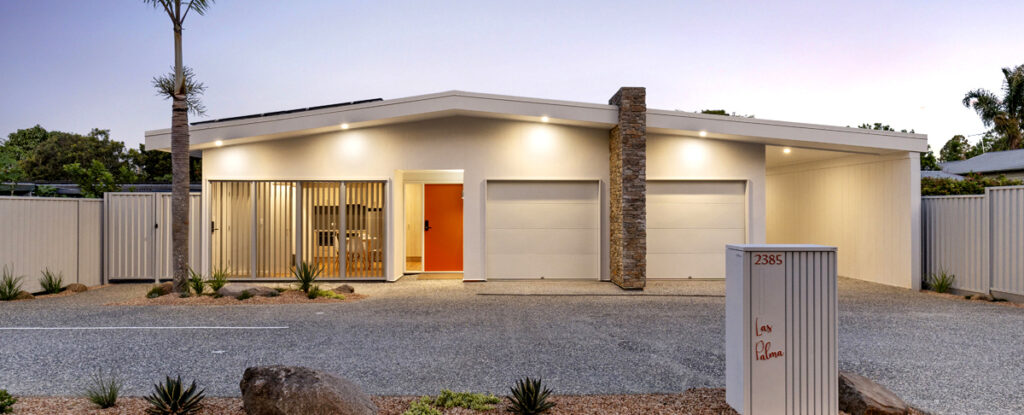
‘La Palma‘, Executive Living Rooming House from the ‘Palm Springs Collection’ by Brisbane Rooming Houses. ©
Who Lives in Executive Rooming Houses?
The outdated stereotype that rooming houses accommodate only disadvantaged or transient residents no longer reflects reality.
Modern executive rooming accommodation attracts a broad cross-section of Australia’s workforce.
Residents commonly include:
- Hospital doctors
- Nurses
- Engineers
- IT developers
- Project managers
- Business owners
- Corporate managers
- Police officers
- Teachers
- Allied health professionals
Many earn well into six figures.
We currently accommodate hospital doctors earning between $180,000 to $220,000 per annum, alongside engineers, software developers and business owners.
These residents choose executive rooming accommodation because of its convenience, quality and flexibility—not because they cannot afford alternatives.
Quality Creates Higher Rent
Our rooms typically lease from approximately $490 per week for entry-level rooms through to $580 or more per week for premium rooms.
This represents annual rental income of approximately $25,000 to over $30,000 per room.
These rents are achieved because every aspect of the property has been carefully designed to maximise resident appeal.
Features such as private ensuites, superior sound insulation, attractive communal spaces, premium finishes and thoughtful layouts all contribute to a better living experience.
The market rewards quality.
Why Two Rooming Houses in the Same Street Can Produce Different Returns
Perhaps the strongest evidence supporting premium design is that competing rooming houses in the same neighbourhood can generate vastly different rental income.
Many rooming houses built by other operators in the same streets lease rooms for between $380 and $420 per week.
Their highest-priced rooms are often cheaper than our lowest-priced rooms.
The suburb has not changed.
The transport has not changed.
The employment opportunities have not changed.
The only difference is the quality of the accommodation and the demographic it attracts.
By targeting higher-income professionals and providing superior accommodation, premium rooming houses consistently outperform lower-quality alternatives.
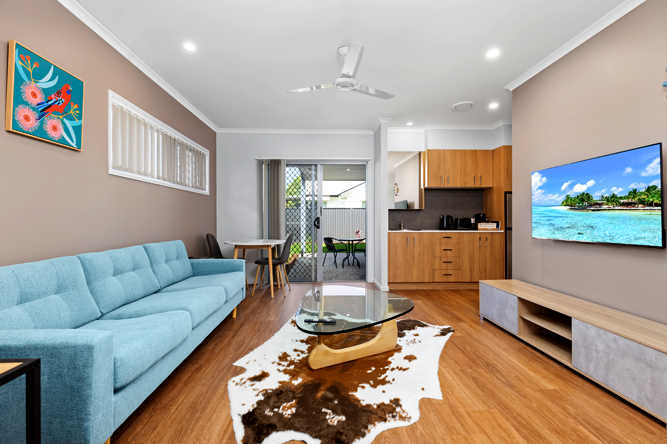
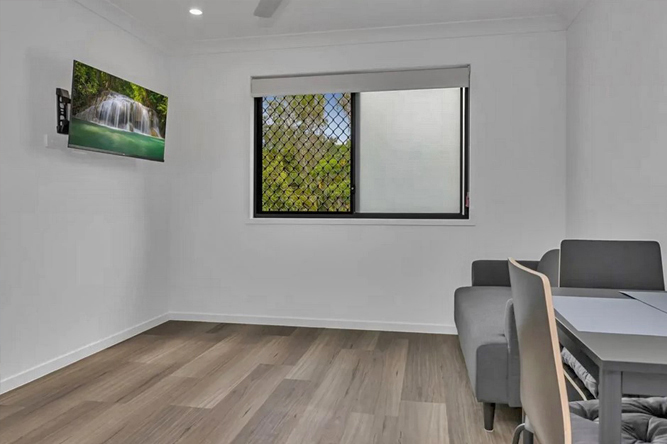
Not all rooming houses are the same. Picture 1, shows a room by Brisbane Rooming Houses ©. Picture 2, shows a room by another builder, with poorly positioned small TV and minimal furnishings.
Looking Beyond Construction Cost
Many investors make the mistake of comparing projects based solely on build price.
While construction cost is important, rental income over the life of the investment is far more significant.
Choosing a builder because they are $50,000 cheaper may appear sensible today.
However, if that decision reduces rental income by $30,000 every year for decades, the long-term financial consequences become enormous.
The cheapest build is not always the most profitable investment.
The Lifetime Value of Higher Rent
The mathematics are compelling.
If a premium rooming house generates an additional $30,000 per year compared with competing properties, over ten years that equates to $300,000 of additional gross rental income.
For investors developing two rooming houses through subdivision or dual development, the additional income could exceed $600,000 over the same period.
These calculations are based on today’s rental levels only.
They do not include future rental growth or the operational savings often achieved through superior design and management.
The long-term financial difference is substantial.
Investors Should Think Long-Term
Property investing is a long-term strategy.
Every design decision made during construction influences rental income for decades.
A slightly larger room.
A better kitchen.
Improved landscaping.
Higher-quality cabinetry.
Superior furnishings.
Quality, long lasting boundary fencing
Each may cost more initially but contribute to stronger rental performance year after year.
Unfortunately, many investors focus entirely on minimising upfront costs, without considering the lifetime income those savings may sacrifice.
In doing so, they may unintentionally rob their future selves of hundreds of thousands of dollars in potential rental income.
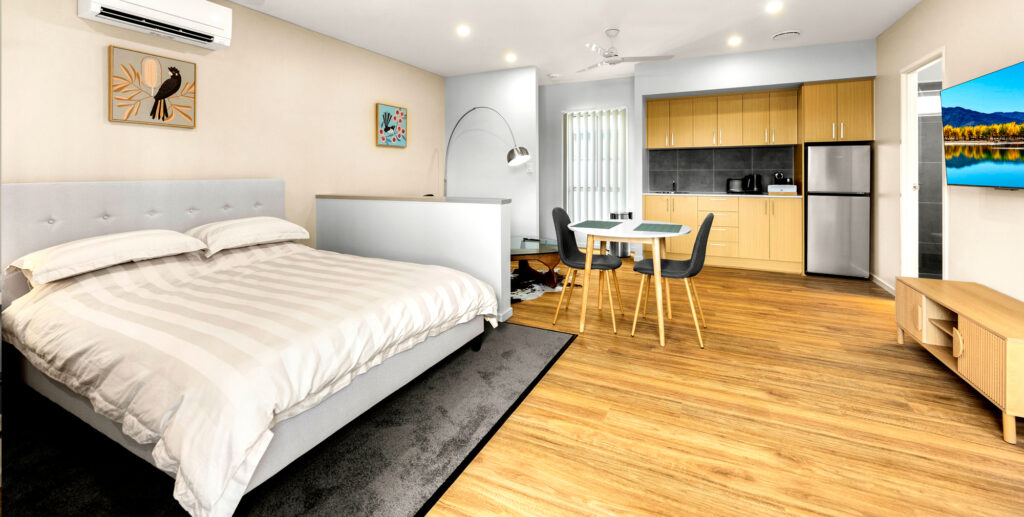
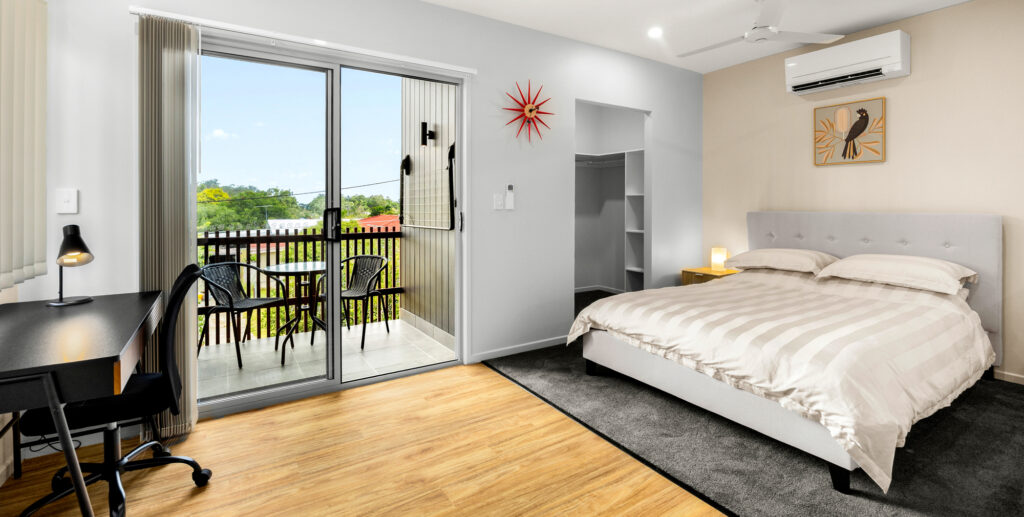
Large, spacious rooms will attract renters wanting a better living experience. © Brisbane Rooming Houses.
The Formula Is Simple
Calculating room rent is not simply about copying competitors.
It is about understanding value.
Higher-quality accommodation attracts higher-quality residents.
Higher-quality residents are willing to pay more for convenience, comfort and presentation.
Premium design produces premium rents.
Premium rents create superior investment performance.
Final Thoughts
The question should never be, “What is everyone else charging?”
Instead, investors should ask:
“What value does my rooming house provide, and who am I designing it for?”
The answer determines everything.
Not all rooming houses are the same.
Not all rooms are the same. Not all renters are the same.
A thoughtfully designed executive rooming house targeting responsible middle and higher-income professionals can generate significantly greater rental income than competing properties in the same street.
Over the life of the investment, the additional income can amount to hundreds of thousands of dollars.
For investors serious about maximising returns, calculating rent is not about finding the cheapest room in the suburb.
It is about creating the best product in the suburb.
When quality, design and management come together, premium rents naturally follow.
About the author:
Paul Zanetti is the Founder and Director of Brisbane Rooming Houses Pty Ltd and has been the leading proponent in Queensland for a new type of rooming houses – ‘Executive Living’ designer studios for key workers.
Paul is also a prominent and active advocate for reform of Queensland’s regulatory framework governing rooming accommodation and affordable housing.
He has prepared and published multiple reports for governments identifying regulatory, planning and infrastructure-charging anomalies affecting rooming accommodation in Queensland. His advocacy has included engagement with State Planning Ministers, senior departmental officers and Directors-General, as well as local government elected representatives, planning officials and other relevant stakeholders.
Paul continues to advocate for evidence-based planning reform and the development of proportionate regulatory frameworks capable of supporting the delivery of affordable housing by the private sector.
Paul can be contacted at: paul@brisbaneroominghouses.com.au