
Queensland councils and utility providers are imposing excessive, inconsistent and unlawful per-room infrastructure charges on five-room, five-occupant low-density rooming accommodation.
Despite being aware of these practices, the Queensland Government has allowed the situation to continue.
Housing is a State government responsibility. The State should take the lead by establishing a transparent, consistent State Infrastructure Charges Framework that clearly regulates infrastructure charges for rooming accommodation.
Queensland is in the midst of a housing crisis.
Council infrastructure charges for rooming accommodation are increasingly being debated because of their significant impact on the viability of privately funded affordable housing.
With rents rising, vacancy rates remaining critically low across much of the State, and governments at all levels seeking to increase the supply of affordable accommodation, removing unnecessary barriers to private investment should be a priority.
One of the fastest, most flexible and cost-effective forms of affordable housing is low-density rooming accommodation.
Queensland’s current infrastructure charging framework is fundamentally flawed. It encourages local councils to impose unlawful, disproportionate infrastructure charges on small-scale, low-density rooming accommodation, exceeding charges for a conventional dwelling, housing the same number of occupants.
The result is creating distortions in the housing market and complicating compliance for operators seeking to offer affordable, compliant lodging.
While higher infrastructure charges may be justified for medium- and high-density residential developments that demonstrably generate greater demand on trunk infrastructure, the same rationale does not automatically apply to a low-density Class 1b dwelling restricted to five rooms and five occupants.
Queensland’s current ‘one-size-fits-all’ approach effectively encourages local governments to impose Council rooming houses infrastructure charges. This punishes affordable housing and discourages private investment as the State struggles to increase housing supply.
The outcome is both economically inefficient and contrary to the Government’s own housing objectives.
Importantly, the Planning Act 2016 and the Queensland Government’s Local Infrastructure Planning Guidance for Local Government and Applicants make clear that infrastructure charges may only be levied where a development generates additional demand on trunk infrastructure.
Despite this statutory framework, many Queensland local governments continue to apply a per-suite infrastructure charge of approximately $27,163.80 per room.
As at 1 July 2026, this results in a gross infrastructure charge of $135,819.00 for a five-room, five-occupant rooming accommodation dwelling (less any applicable credit for the existing lawful use).
In many instances, these charges appear to have been imposed without a demonstrated assessment of whether the development generates a corresponding increase in demand on trunk infrastructure, as required by the Planning Act 2016 and the State’s own Local Council Infrastructure Planning Guidance.
The anomaly stems from the Planning Regulation 2017.
While Schedule 6 (Part 2) treats low-density rooming accommodation as a distinct housing type by limiting it to a maximum of five rooms and five occupants, Schedule 16 (Prescribed Amounts) groups all rooming accommodation within the same infrastructure charging category as medium- and high-density accommodation, including retirement facilities and community residences, which are not subject to the same statutory limits.
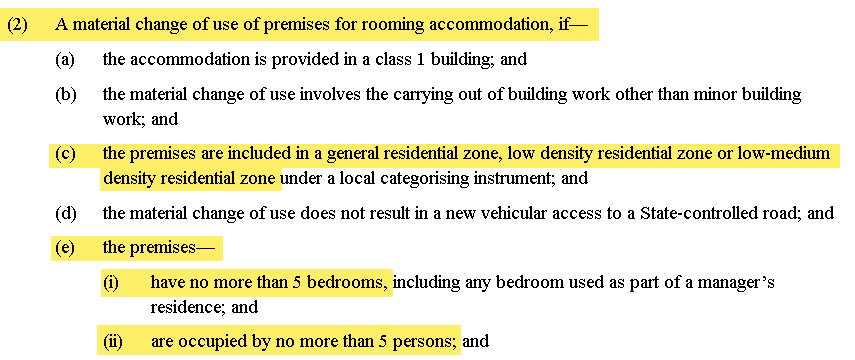
(Above) Schedule 6 (Part 2) of the (Queensland) Planning Regulation 2017 limits low-density rooming accommodation to 5 bedrooms and 5 persons (occupants).

(Above) Schedule 16 of the (Queensland) Planning Regulation 2017 sets per room (suite) infrastructure charges at $27,163.80 regardless of room (suite) numbers.
The Two-Stage Assessment Required Before Infrastructure Charges Can Be Levied
Local Queensland councils must undertake a two-stage assessment before imposing infrastructure charges on a development.
1. First, establish whether the development creates additional demand
Council must first have regard to the Planning Act 2016 and the applicable infrastructure-planning framework to determine whether the particular development creates additional demand on trunk infrastructure.
This is not simply a matter of assuming that every new development generates additional demand. The relevant question is whether the specific development under assessment creates additional demand beyond existing lawful use rights or development capacity.
The assessment should therefore consider the actual impact of the individual development on relevant trunk infrastructure, including, where applicable:
- water supply and sewerage;
- stormwater infrastructure;
- transport infrastructure and road networks;
- parks and recreational infrastructure;
- libraries and community facilities; and
- other trunk infrastructure identified within the relevant infrastructure-planning framework.
Importantly, the assessment must relate to the individual development being assessed.
Council cannot aggregate the impacts of multiple unrelated developments, subdivisions or dwelling approvals and attribute those cumulative impacts to a single development.
For example, where a five-room, five-occupant low-density rooming accommodation dwelling is proposed, Council should be able to demonstrate that that particular development generates additional trunk infrastructure demand.
2. If additional demand exists, quantify it and establish the associated cost
Only after establishing that additional demand exists should Council determine the extent of that additional demand and identify the infrastructure requirements attributable to it.
Council should then be able to demonstrate:
- what additional infrastructure demand is generated;
- what infrastructure capacity or upgrades are required as a consequence;
- the extent to which those requirements are attributable to the development; and
- the reasonable and proportionate cost associated with addressing that additional demand.
Only after these matters have been established should an infrastructure charge be calculated and levied.
The result is that a tightly capped, low-density residential dwelling is charged as though each individual room were an independent infrastructure-generating unit, notwithstanding that the development operates within a low-density residential setting.
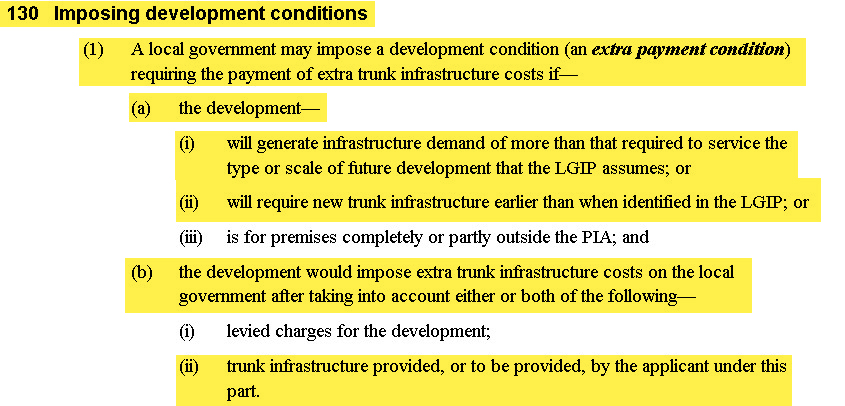
Sections 120, 128 and 130 of the Planning Act 2016, together with the Queensland Government’s Infrastructure Planning Guidance for local governments, establish a different test.
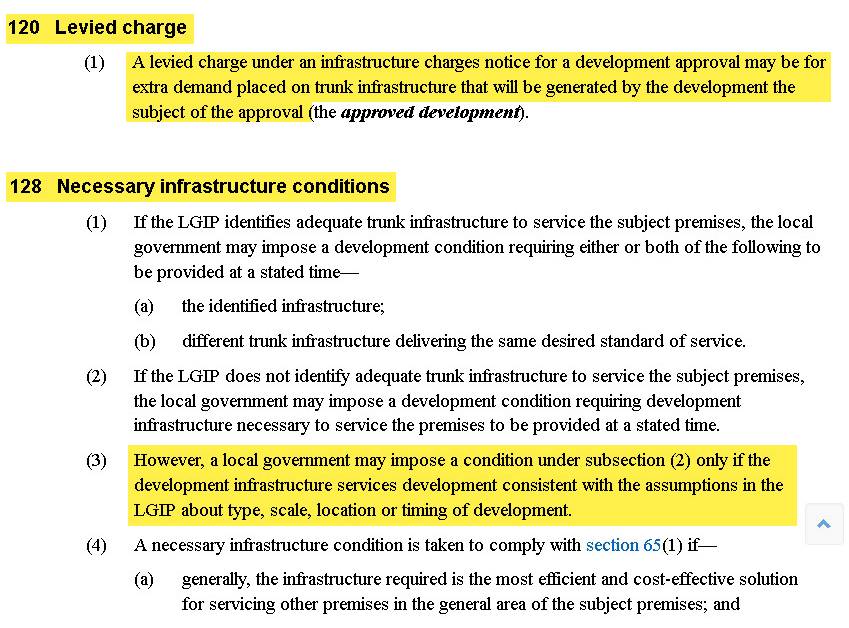
(Above) Section 120 and 128 of the Planning Act clearly state infrastructure charges may be for extra demand on trunk infrastructure generated by the development.
The guidance states on page 17 that:
“The local government needs to demonstrate that the development will impose extra trunk infrastructure costs on the local government.”
Below is an extract from the State Government’s Guidance (Page 17):
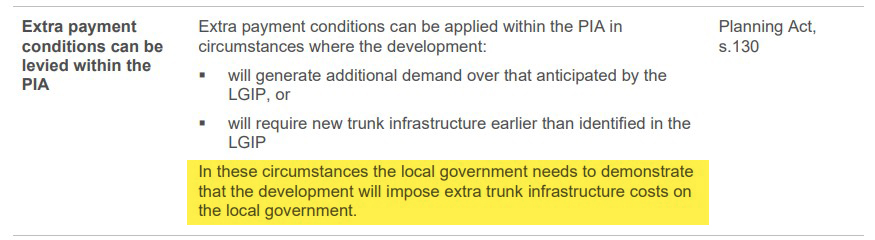
The extract (above) is drawn from Section 130 of The Planning Act (see below):
This raises a fundamental question:
Should a strictly capped, low-density Class 1b rooming accommodation dwelling, capped at 5 rooms with 5 occupants, with no greater demonstrated extra demand that a comparable Class 1a residential home be charged as though it were a medium- or high-density development simply because it contains multiple bedrooms and ensuites?
The answer is clearly and evidently no.
Infrastructure charges should be determined by the additional demand a development places on trunk infrastructure – not by housing tenure, the number of bathrooms or ensuites, or the internal configuration of a dwelling.
The relevant assessment should be based on recognized infrastructure demand indicators such as population, equivalent persons, water consumption, wastewater generation, storm water runoff and traffic generation.
In practice, however, many Queensland councils have defaulted to a mechanical per-room charging methodology without first establishing that a corresponding increase in trunk infrastructure demand exists. This approach is inconsistent with both the Planning Act and the Queensland Government’s own Infrastructure Planning Guidance.
Equally concerning is the absence of a clear State framework distinguishing low-density rooming accommodation from medium- and high-density developments for infrastructure charging purposes. This has left local governments without consistent policy direction and has resulted in widely adopted charging practices that may not properly reflect the statutory requirement that infrastructure charges be proportionate to the additional demand generated by development.
Under successive Queensland governments, Planning Ministers, Directors-General and senior departmental advisers, this structural anomaly has been allowed to persist, contributing to the continuing shortage of affordable housing across the State.
This is not a matter of government being unaware of the issue. Over several years, the author of this article has presented detailed reports and legal submissions to the Department of State Development, Infrastructure, Local Government and Planning and has met with Ministers, Directors-General, Deputy Directors-General and senior planning advisers.
While there has been broad acknowledgment that the issue warrants examination, no meaningful reform has yet been implemented.
The consequence is a planning framework that continues to discourage one of Queensland’s most efficient forms of affordable housing at a time when increasing housing supply has never been more critical.



(Above) Planning Ministers under successive governments have failed. Left to right. Steven Miles, Meaghan Scanlon, Jarrod Bleijie.
The issue is not whether medium- and high-density rooming accommodation should contribute appropriately to infrastructure. Larger developments can create greater demands on infrastructure and may properly require a different charging methodology.
The issue is the treatment of low-density Class 1b rooming accommodation.
A small-scale Class 1b rooming accommodation dwelling in Queensland is limited to five rooms and five occupants under the Planning Regulation 2017.
It is fundamentally different from a large, multi-suite rooming accommodation development. The infrastructure-charging framework should recognize that distinction.
But it doesn’t.
The Central Disparity
Under Queensland’s planning framework (as previously demonstrated), low-density rooming accommodation is subject to strict limitations on its scale and occupancy in Low Density Residential (LDR) and Low Medium Residential (LMR) zones.
A small Class 1b rooming accommodation development in a low-density residential environment is limited to:
- five rooms; and
- five persons.
This is a very different development model from a large-scale accommodation project containing dozens or hundreds of rooms (medium or high density developments in Medium Density or High Density zones) .
However, the infrastructure-charging methodology effectively treats each individual room or suite as a separate infrastructure-generating unit, even though the definition of rooming accommodation in Queensland is that it cannot be a self-contained unit. If it is, it will not be approved in a low-density residential or low-medium residential zone. For example, laundries are shared, not located in each room..
Using the current figures (1st July 2026) a five-room development may attract an infrastructure charge of approximately:
$27,163.80 × 5 suites = $135,819.00
After adding the new lot infrastructure charge of $38,029.25, the rooming accommodation development infrastructure charges equate to $173,848.25 for a 5 room dwelling for 5 occupants.
This is clearly untenable.
By comparison, an ordinary Class 1a residential domestic dwelling house attracts a single flat-rate infrastructure contribution of approximately $38,029.25 (to fund the infrastructure for a new lot paid after creating the new lot), despite having no equivalent statutory limit on the number of bedrooms, bathrooms or occupants.
This creates a difference of approximately $135,819.00 between a Class 1b rooming accommodation dwelling and a Class 1a family home, effectively placing the same – or less – demand on trunk infrastructure.
The disparity warrants serious State government examination because it arises substantially from the regulatory classification and tenure structure of the accommodation, rather than from any demonstrated equivalent increase in demand on water, wastewater, storm water, community centers, libraries, widening of roads or new roads that infrastructure charges are designed to fund..
In practical terms, five people living in a conventional residential dwelling house and five people living in five private rooms in a low-density rooming accommodation development still remains just five human beings using infrastructure.
The question is. whether the infrastructure demand is genuinely five times greater simply because the accommodation contains five private ensuites.
The “Bathroom Multiplier” Problem
The current methodology places considerable emphasis on the number of rooms or suites. But internal building configuration is not necessarily the same thing as external infrastructure demand.
Water supply and wastewater infrastructure are fundamentally concerned with matters such as:
- the number of people using the network;
- water consumption;
- wastewater generation;
- peak hydraulic flows; and
- the capacity of existing infrastructure
A bathroom is a physical fitting. It is not, by itself, a human consumer. Five people do not necessarily generate five times the infrastructure demand simply because they occupy five rooms, each with a private bathroom. A person does not consume more water, brush their teeth more frequently, flush more toilets or shower more frequently merely because they are an unrelated tenant rather than a member of a family household.
This is the central concern with a methodology that effectively treats each room as a separate infrastructure demand generator without demonstrating that the resulting infrastructure demand is proportionately greater.
If the charge is based on actual infrastructure demand, there must be evidence supporting the relationship between the charge and that demand.
That evidence might include:
- water-metering data;
- hydraulic modeling;
- wastewater flow data;
- peak-demand analysis;
- infrastructure capacity assessments; and/or
- other empirical engineering evidence.
The issue is not whether infrastructure demand can vary between different developments – of course it can. The issue is whether the charging methodology is based on a demonstrated relationship between the actual demand created by the development type – and the amount charged.
A Low-Density Rooming House Is Not A High-Density Development
The most important distinction in this debate is between low-density rooming accommodation and medium- to high-density rooming accommodation.
They should not be treated as a single undifferentiated category.
A small, five-room Class 1b dwelling in a low-density residential zone is fundamentally different from:
- a large boarding house;
- a multi-story accommodation building;
- a high-density, multi-story rooming development;
- a development containing dozens of suites; or
- a large-scale commercial accommodation complex.
The infrastructure demands, traffic generation, population intensity and development scale are materially different. Accordingly, the infrastructure-charging framework should contain at least two distinct categories.
Category 1: Low-Density Class 1b Rooming Accommodation
This category would include strictly limited rooming accommodation in low-density residential environments.
For example:
- up to five rooms;
- up to five persons (the occupants); and
- development consistent with the applicable low-density planning controls.
For infrastructure-charging purposes, this category should be treated on an equivalent basis to a low-density Class 1a dwelling house.
Category 2: Medium- And High-Density Rooming Accommodation
This category would include larger and more intensive developments. These developments may appropriately be subject to a separate infrastructure-charging methodology that reflects their:
- scale;
- intensity;
- occupancy;
- demonstrated infrastructure demand; and
- impact on trunk infrastructure.
This article does not seek to prevent appropriate infrastructure charges applying to larger rooming accommodation developments. It seeks to ensure that a low-density, strictly capped dwelling is not charged under a methodology designed for materially more intensive forms of development.
For rooming accommodation, the National Construction Code (aka. The Building Code of Australia) is the national guide, used by Victoria for its allowable occupancy.
For low density rooming accommodation, a Class 1b dwelling, is defined as:
- Occupancy limit: It must ordinarily accommodate no more than 12 people.
- Size limit: The total area of all floors must not exceed 300 m² (measured over the enclosing walls)
The Victorian Benchmark
In Queensland, a further issue is the absence of a clear, transparent and proportionate benchmark for determining how infrastructure charges should be calculated for low-density rooming accommodation.
This is where the Victorian framework becomes relevant. Victoria provides an important comparative reference point because its infrastructure contribution frameworks generally calculate contributions by reference to the dwelling, development site, land area or gross floor area, rather than automatically treating every individual room within a rooming accommodation development as a separate infrastructure-generating unit.
This approach is consistent with a more transparent and proportionate methodology. The Victorian approach is not being advanced here as a mandatory legal rule that Queensland must simply copy. Rather, it provides the most relevant available comparative benchmark for examining whether Queensland’s current approach is rational, proportionate and defensible.
The core principles reflected in the Victorian development-contribution framework include:
- Need — the development should generate a genuine infrastructure requirement;
- Nexus — there should be a demonstrable connection between the development and the infrastructure funded;
- Apportionment — the development should pay its fair share of the infrastructure cost; and
- Reasonableness — the contribution should be proportionate and not excessive in relation to the development.
These principles provide a useful framework for assessing Queensland’s current methodology. Importantly, Queensland does not appear to have an equivalent clear and comprehensive benchmark that explains why a small, low-density Class 1b development should attract a substantially greater infrastructure charge than a conventional dwelling house accommodating a comparable number of people.
In the absence of a clear Queensland framework, principle or threshold, Queensland should establish its own framework based on transparent and defensible principles.
The current absence of a clear, fair and proportionate framework should not mean that the most aggressive available charging methodology for a medium or high-density development becomes the default for a low-density dwelling.
A Practical Solution
A relatively simple reform could resolve much of the problem.
Low-density Class 1b rooming accommodation, subject to the applicable five-room and five-occupant limitations, should be placed into a separate category under the infrastructure-charging framework. That category should be assessed at the same flat-rate infrastructure charge applicable to a comparable low-density Class 1a dwelling house.
Using the figures relied upon in this article, this would mean an infrastructure contribution of approximately: $38,029.25 per development rather than $173,848.25 (i.e. the new development lot plus the per suite infrastructure charges) based on five separate suite charges.
That is 457.14% or 4.57 times higher for no verified higher demand on trunk infrastructure.
A separate methodology should apply where a development exceeds the low-density threshold. For example, where additional rooms are proposed and a development application is required, additional infrastructure charges could be calculated using a transparent per-room formula.
Based on an average Queensland dwelling comprising approximately three rooms and an approximate infrastructure charge (depending on local council) of approximately $38,029.25 (for a new lot) as at 1 July 2026, the true and accurate equivalent amount of per-room (or per suite, where a suite is a room attached to an ensuite) is approximately $12,676.41 per room. It is not the existing $27,163.80 per 1- or 2-bedroom suite.
Accordingly, additional rooms beyond the low-density threshold could attract a proportionate charge of approximately $12,676.41 per additional room/suite, subject to the applicable planning and infrastructure framework.
This would create a graduated system rather than a cliff-edge charging model.
It would recognize the difference between:
- a small, low-density rooming accommodation dwelling;
- a larger development requiring additional assessment; and
- a medium- or high-density accommodation project.
The Broader Housing Implications
Infrastructure charges are not merely accounting figures. They directly affect whether projects proceed.
An additional infrastructure charge of over $135,000.00 above the charge applicable to a comparable dwelling materially affects:
- project feasibility;
- construction costs;
- investor returns;
- financing;
- rents; and
- the overall supply of affordable accommodation.
Private-sector housing providers are responsible for delivering a substantial proportion of Australia’s housing supply. If the policy objective is to increase affordable rental accommodation, infrastructure charges should not inadvertently make the delivery of affordable housing financially nonviable.
This is particularly important for regional Queensland. In many regional cities, where vacancy rates average less than 1% there is a critical shortage of affordable housing for workers, students, retirees and other residents who cannot afford conventional housing. Purpose-built rooming accommodation provides an efficient and flexible housing option.
It is delivered more quickly than many traditional housing models, but excessive upfront charges undermine the very housing supply that government policy seeks to encourage. This creates an obvious policy contradiction.
On one hand, government planning frameworks need to create pathways intended to facilitate rooming accommodation.
On the other hand, the infrastructure-charging framework imposes substantial additional costs on the same development.
The result is a system that encourages the development in principle while making it more difficult to deliver in practice.
The Question Of Historical Charges
The issue also has retrospective implications. If it is ultimately determined that low-density Class 1b rooming accommodation has historically been charged under an inappropriate or legally invalid medium- or high-density methodology, questions arise regarding infrastructure charges previously imposed and paid.
This includes consideration of:
- whether individual charges were correctly calculated;
- whether the relevant statutory category was correctly applied;
- whether the underlying methodology was legally valid;
- whether appeal rights remain available;
- whether judicial review is available; and
- whether repayment, restitution or other relief may be available in appropriate circumstances.
A retrospective claim requires legal examination. Administrative reform alone would not necessarily determine the legal position concerning historical charges. However, prospective reform should not automatically be treated as extinguishing potential claims in respect of charges that may ultimately be found to have been unlawfully or incorrectly imposed.
This issue may become particularly significant if multiple developers and property owners have paid excessive per-suite charges over an extended period and are willing to fund a class action against local governments (councils) that have applied incorrectly calculated infrastructure charges.
The Preferred Outcome Is Reform, Not Litigation
Going forward, the preferred outcome is not litigation. The preferred outcome is a clear, principled and proportionate Queensland infrastructure-charging framework established through consultation, mediation and administrative reform.
Low-density Class 1b rooming accommodation should be recognized as a distinct category. It should not be charged as though it were a medium- or high-density development merely because the accommodation contains multiple private rooms.
If a development is genuinely low-density, strictly capped and comparable in infrastructure demand to a conventional dwelling house, the infrastructure charge should reflect that reality. The Victorian framework provides the most relevant available comparative benchmark for examining this issue.
If consultation and administrative reform successfully establish a fair Queensland framework, that benchmark can serve as a constructive reference point for reform.
If reform does not occur, the same comparative benchmark may become relevant as an analytical and evidentiary reference point in any subsequent judicial application examining whether Queensland’s current methodology is rational, proportionate, properly founded and legally sustainable. This is not an argument that Queensland must simply adopt Victoria’s system. It is an argument that Queensland must develop a coherent system of its own.
A system that clearly identifies:
- the infrastructure demand created by a development;
- the relationship between the development and the infrastructure funded;
- the fair share of infrastructure costs attributable to that development; and
- a reasonable and proportionate contribution.
A Practical Opportunity For Queensland
Queensland has an opportunity to establish a clearer and more modern infrastructure-charging framework for rooming accommodation. The solution is not to eliminate infrastructure contributions. The solution is to ensure that infrastructure charges are:
- evidence-based;
- transparent;
- proportionate;
- logically connected to infrastructure demand; and
- appropriately differentiated according to development scale.
A low-density five-room Class 1b dwelling should not automatically be treated as five separate high-density infrastructure-generating units. Nor should affordable housing be penalized simply because its residents are unrelated renters rather than members of a family living in a conventional dwelling. The question should be the infrastructure demand created by the development.
Not the relationship between the occupants. Not their tenure.Not whether they share a surname.
The preferred outcome is a collaborative solution that supports housing supply, protects the integrity of the planning system and provides certainty for developers, investors, councils and residents.
However, if a fair and legally sustainable framework cannot be established through constructive engagement, the legal validity of the current methodology may ultimately require independent judicial consideration.
The better outcome for everyone is to resolve the issue before that becomes necessary.
Queensland needs more affordable housing. Its infrastructure-charging framework should help make that possible — not make it harder.
About the author:
Paul Zanetti is the Founder and Director of Brisbane Rooming Houses Pty Ltd, a developer, builder and property manager of rooming accommodation.
Paul has been the leading proponent in Queensland for a new type of rooming houses – ‘Executive Living’ designer studios for key workers – a proprietary model that delivers exceptional returns to investors.
He has written books on rooming accommodation, referred to as ‘industry bibles’ and prepared and published multiple reports for governments identifying regulatory, planning and infrastructure-charging anomalies affecting rooming accommodation in Queensland. His advocacy has included engagement with State Planning Ministers, senior departmental officers and Directors-General, as well as local government elected representatives, planning officials and other relevant stakeholders.
Paul continues to advocate for evidence-based planning reform and the development of proportionate regulatory frameworks capable of supporting the delivery of affordable housing by the private sector.
Where appropriate reform cannot be achieved through constructive engagement with State and Local Governments, Paul is prepared to work with affected industry participants to pursue appropriate administrative reviews and judicial applications to obtain independent consideration of the legality, validity and proportionality of the relevant regulatory frameworks
Paul can be contacted at: paul@brisbaneroominghouses.com.au